

Gettysburg Addressed
bread for the bicentennial

This piece is ‘narrated’ by Robert Todd Lincoln, eldest son of Abraham. The italics in the first and second sections are his—recorded thirty years after Edwin Booth, brother of John Wilkes, saved his life on a rail platform in New Jersey. The other italics are taken from the Gettysburg Address. The stages of wheat’s growth are in bold.
The brother of Lincoln’s assassin saves the life of the President’s son, a few months after the Battle of Gettysburg, which ended one day before the 4th of July. There’s a metaphor for our country in all this that I cannot find.
To the leaven’d soil they trod calling I sing for the last…
And responding they answer all, (but not in words,)
The average earth, the witness of war and peace, acknowledges mutely,
The prairie draws me close, as the father to bosom broad the son,
The Northern ice and rain that began me nourish me to the end,
But the hot sun of the South is to fully ripen my songs.
Drum Taps
Walt Whitman
Sowing
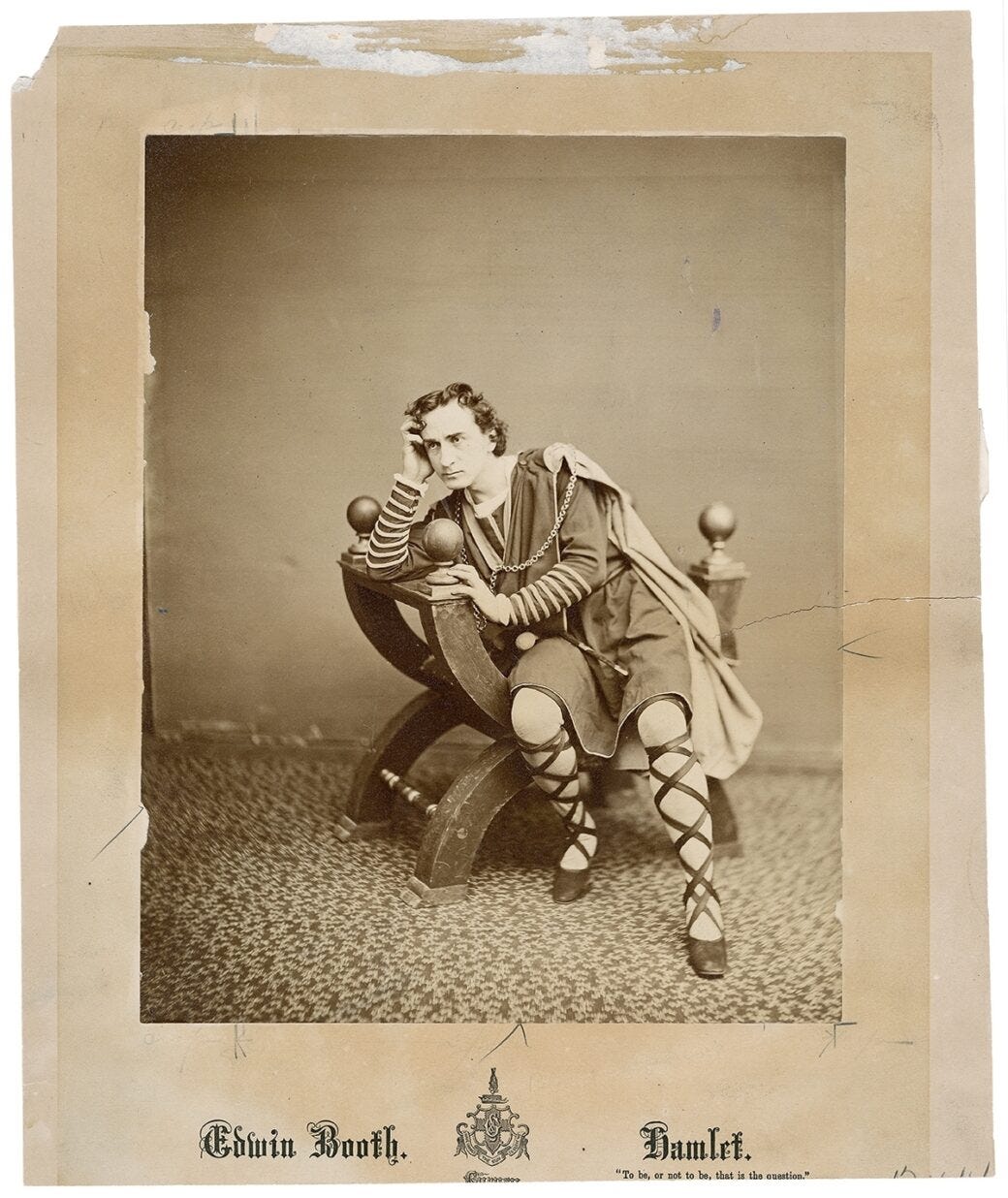
It’s a few months after Gettysburg and despite being the President’s son, I am still waiting my turn in this midnight. Across the Hudson the gaslamps of New York are glowing like candles low on wax. Even in this darkness the station smells of pipesmoke and horseshit.
That was my last thought before my body was terribly pressed against other passenger’s flesh, against the steel of the train, the leather of their boots, all of which began to clamor towards the incoming carriage. In this situation the train began to move, and by the motion I was twisted off my feet, and had dropped somewhat, with feet downward, into the open space, and was personally, helpless. I had fallen on the track like a seed dropped into a dark wet hole and I saw the train coming at me like a huge slow plow and my Harvard mind did arithmetic about which part of me would be crushed first—shoulder, if I angled my torso; pelvis if I protruded like a dancer; arm if I bade it to stop like a priest. It was then, in the middle of my equationing, that I was pulled by the collar and shoulder, quite simply as if I were a stalk of wheat, from the root up and out of the soil. As quickly as I had fallen, I was now back on the platform and looking into the breathless face of Hamlet.
So I expressed my gratitude to him, and in doing so, called him by name. But this man was not Hamlet. Tonight Edwin Booth was himself, brother to the man that you know will kill my father. And with him that evening was John Ford, owner of Ford’s Theatre. If only I could have asked for a ticket that night at the train station, if only I knew what bullet and what dialogue was on the playbill eighteen months hence. But I failed to address Mr. Ford. The affair was all over in three seconds.
We are met on a great battle-field of that war.
Reaping, part one
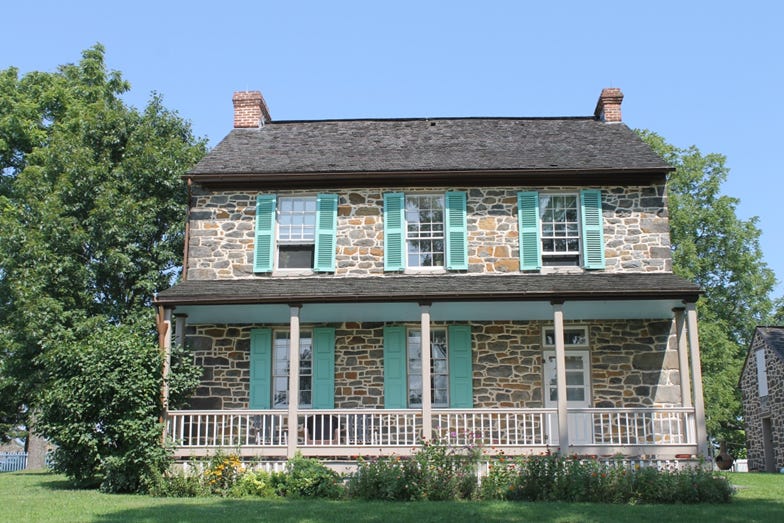
In a field eighty six miles from Gettysburg, Abraham—no, not my father—but Abraham Fultz, is reaping wheat with his good shoulder. It’s 88° on July 1, 1863 and Abraham wipes sweat from his brow, a clean lyrical gesture, as if brushing away a candid thought in church. Then with his free hand he rummages in his cotton pocket for a whetstone, the size of the dorsal on that four pound bass he pulled from the river last summer, the one the missus dredged in buttermilk and fried in cornmeal. With the flavor of that memory in his mouth, he uses saliva to lubricate the granite, to then trace the heavy iron across its body, soon testing the sharp dullness against the thick leather of his thumb.
The wheatstraw this year is thin, brittle, easy to fell. He knows that ready roots betray a pliable straw. But the wheat berries are plump and ripe enough. He is happy with this new variety of his, like its heading and tillering and is proud of its tallness, taller than his president. Rainfall was decent this year, irrigation sufficient.
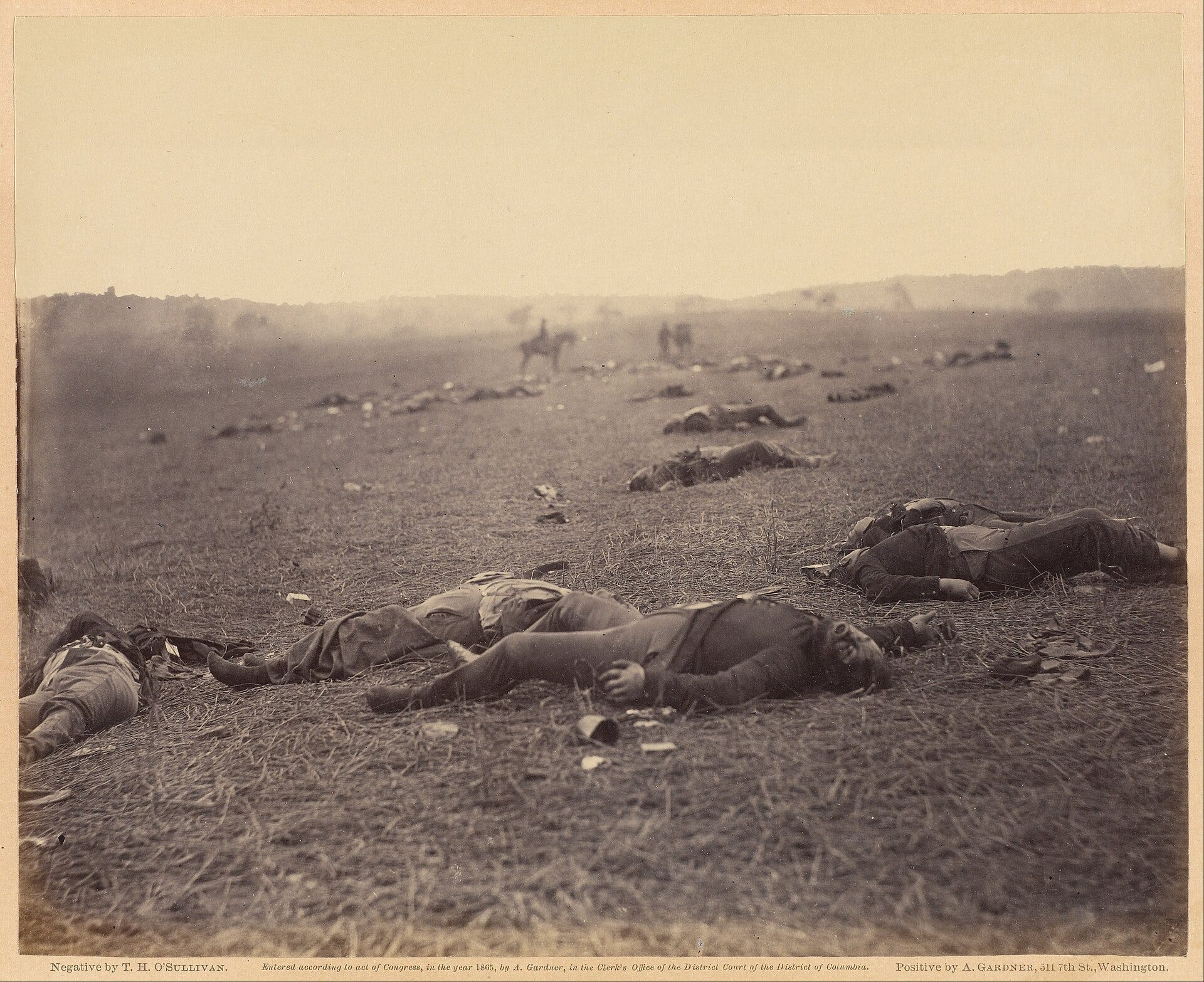
As he begins to reap, cannons boom south of his farm announcing the first day of the largest and deadliest battle to ever take place on America soil. For the next two days, sixty thousand more cannon will drill explosive metal seeds into the moist earth of men’s bodies.
Abraham will hear their evidence, like notes from a hymn he does not recognize. Along with birdsong and his wife’s call for supper, he will hear them forever.
Threshing
My Abraham swore he’d never work wheat by hand again. He hated it—especially the threshing. On the family’s farm in Indiana, father did all the chores. But the beating of the wheat with a wooden club, separating the stalks and straw from the husks, was too hard on his shoulders, aching them as much as they muscled him. With muffled groans out beyond his father’s ears, he thought it erroneously stupid—cutting a plant to make food, hitting little seeds lifeless so they would release their energy to give us bread.
Most people commented on his broad shoulders while in office. Even when they began to droop, I knew that this threshing wheat built the architecture of his body.
The world will little note, nor long remember, what we say here, but it can never forget what they did here.
Reaping, part two
In a field zero miles from Gettysburg, George Rose is preparing to harvest wheat with his good shoulder. It’s 88° on July 1, 1863 and Rose wipes sweat from his brow, a clean lyrical gesture, as if brushing away a candid thought in church. Troops have been coming in and out of Gettysburg for days with gossip of battle—but he must harvest while the weather is ripe and the war is still in the South. So he prepares his steel for reaping.
Charles Teague, a Ranger who fought at Gettysburg, compiled a booklet called
“Gettysburg by the Numbers”. He put the average height of a soldier there at 5’8”.
Soldiers at Gettysburg described the wheat in Rose’s field as “breast high and ready to be cut.” As high as the heart of the average man sent to die there. No taller.
During the battle in Rose’s wheatfield, advancing Confederates trampled the ripe grain. Their boots and shoeless toes plowed through the field towards Union troops, with only their heads being seen. Better for aim, “breast high and ready to be cut.” One soldier remembered, after Pickett’s charge, “not a stalk could be found, for it was all trodden out of sight”.
6,000 soldiers died amongst nineteen acres in Rose’s ripe wheatfield. If the men were cutting this grain, instead of killing each other in it, the harvest would have yielded 18,000 pounds. Applying simple arithmetic, each dead man took with him three seeds to his death.
Teague put the average height of a soldier there at 5’8”. No taller.
Binding
One soldier from the 77th New York Infantry wrote, “As we passed the scene of conflict on the left was a scene more than unusually hideous. Blackened remains marked the spot where, on the morning of the 3rd, stood a large barn. It had been used as a hospital. It had taken fire from the shells of the hostile batteries, and had quickly burned to the ground. Those of the wounded not able to help themselves were destroyed by the flames, which in a moment spread through the [wheat] straw...The crisped and blackened limbs, heads and other portions of bodies lying half consumed among the heaps of ruins and ashes made up one of the most ghastly pictures ever witnessed, even on the field of war.”
After ripe wheat is cut, it’s bound into sheaves. Most often used was twine, or
another stalk of wheat to fasten them. Sheaves were then taken to a barn to be dried and be winnowed.
Had it not been for the battle, Rose would have filled that same barn with those 18,000 pounds of sheaved wheat.
“This is the last of earth,” an Alabaman casualty wrote from Gettysburg.
“Write to me. I may get the letter.”
We have come to dedicate a portion of that field as a final resting place for those who here gave their lives that that nation might live.
Winnowing
After reaping and threshing and binding, the grain and chaff are now separated. The entire mixture is tossed into the air—gravity pulls the heavier grains, wind carries the lighter ones. With these fallen seeds, bread is made.
Or more seed is grown.
Sowing, part one
How to prepare a field for wheat?
“After winnowing, sow seeds in moist ground no later than Thanksgiving. Plant them a few fingers apart, patting firmly into firm soil.”
A farmer’s rule of thumb is to plant seeds at a depth about three times their width. Otherwise, they won’t have enough room for displacement, won’t get enough energy for germination.
During The Battle, the dead were buried in mass graves, thrown like so many seeds into fresh earth irrigated with new blood. The average depth of these graves was twelve to eighteen inches. The average width of a soldier was about eighteen inches. These don’t match.
List of soldiers of the 1st Massachusetts Infantry, killed at Gettysburg, compiled with identifiable traits by their staff sergeant:
F. Henry Hartley 1st Lt. Killed (In head).
Y. Henry Parkinson Capt Breast (serious)?
H. Hall Col. Sergt. d-d good soldier
Samuel B. Bassett Segt. Face & Neck (serious)
George Allen Mers. straggler.
A. Farnham Corp died in prison after deserted.
H. L. D. Phillips Sergt. Coward.
List of wheats most likely grown by George Rose at Gettysburg, with notes from their seeds catalogs about identifiable traits:
Fultz:
“Plant winter habit, midseason, midtall; stem purple, midstrong, spike, awnless, oblong-fusiform, inclined to nodding; glumes glabrous, white, midlong, midwide; shoulders midwide; beaks yarrow to midwide, obtuse, long; apical awns few, 3 to 15 mm long, kernels pale red, ovate; germ midsized; crease usually midwide, shallow to middeep; cheeks rounded to angular.”
Fulcaster:
“Plant winter habit, midseason, midtall; stem purple, strong; spike awned, fusiform, middense, Inclined; glumes glabrous, white, midlong, midwide to wide; shoulders midwide, oblique to square; beaks 2 to 8 mm. long; awns 3 to 6 cm. long; kernels red, midlong, soft, ovate, humped; germ midsized; crease midwide, middeep, sometimes pitted; cheeks usually angular; brush midsized, midlong.”
Lost Nation:
“Lost Nation is an old awnless spring wheat of the northeastern United States, which has now gone out of cultivation.”
But, in a larger sense, we can not dedicate—we can not consecrate—we can not hallow this ground.
Acoustic Shadows
“Yes, roots can make noise underground, though not all of it is audible to humans. Plant roots emit subtle clicks and pops as they grow, and they also produce higher-frequency ultrasonic sounds when stressed by drought or physical damage.”
Gettysburg was heard hundreds of miles away: the 12-pounder Napoleon and 3-inch Ordnance Rifles, the 12 pound Howitzers and Whitworth Rifles were cacophonous and amplified for dozens of miles in every direction. 150 miles away, in Pittsburg, their explosions were audible. And their cannon could be heard as far away as Philadelphia. Perhaps that’s why the Liberty Bell stayed cracked.
During The Battle, the Union army fired 32,781 artillery rounds and the Confederates about 25,290. Yet, some soldiers just ten miles from the battle couldn’t hear a thing. This is because of acoustic shadows, regions of sound in which immediate listeners cannot hear because something is blocking the sound’s path, or bending, or refracting its waves in other directions.
If a plant is stressed, it makes rapid and loud ultrasonic clicks. Animals can hear them—mice and insects, for example. And while these might be audible to us humans if we were listening closely, they are often very faint.
Sowing, part two
Before the war, my father wore no beard at all.
A year before The Battle, in May 1862, Abraham (not my father) was walking through a field of Fulcaster wheat. He was surprised to see three spikes of beardless wheat within this ocean of bearded grain. He plucked those three and sowed them, continued sowing their children, until “he obtained sufficient seed to distribute it pretty well over the country” to farmers like George Rose.
In the same month, in the same year, Abraham (my father) established the Department of Agriculture. He nicknamed it the People’s Department, determined that it serve farmers and provide food to all.
Father grew a beard after his first inauguration. Grace Bedell, an eleven year-old girl suggested it, told him a beard would make his thin face look better. And help win votes.
Six years after my father was killed, every single state, including each and every one which seceded from the Union, received free seed of Fultz’s beardless wheat from the Department of Agriculture.
That this nation, under God, shall have a new birth of freedom, and that government of the people, by the people, for the people, shall not perish from the earth.
The Gettysburg Address
My father gave it on November 19, 1863. Exactly one week later, at the same time the country sowed its wheat, he celebrated the first official Thanksgiving. The establishment of this holiday was prompted by The Battle.
I wasn’t there that day. But the amputee was, the artilleryman with clankering teeth was, the captain with a morphine chippy was. All dripping with tobacco juice spittle, all uncorking public pints of hooch and hope. The roots of the trampled wheat were there too, under all their feet, next to the bones without enough depth or width, in George Rose’s wheatfield.
The vast majority of the 15,000 living in the crowd did not hear the Gettysburg Address. Too much noise, too many heartbeats. Too many new roots emitting clicks and pops as they grew. Too much acoustic shadow. So much so that the men he was addressing, the country he was serving, did not plant the seeds of his words because, on that day, my father spoke without amplification.
You are an original in the best sense. You manage to create a travel back in time which resonates in me so strongly. Evaporating from the text are sounds, voices, chaos, bringing back the battle but from an unexpected angle.